

Nine Mile Creek Corridor Renewal
Prioritizing restoration, sustainability and desirable amenities so the Nine Mile Creek Corridor and Moir/Central Park continue to connect residents to nature and outdoor activities.
WORK GETS UNDERWAY AND PARK CLOSES SEPTEMBER 7, 2026
On September 7 the entirety of Moir/Central Park, including all trail access points, will close as major construction is set to begin on the Nine Mile Creek Corridor Renewal Project. Signage and physical barriers will be installed to communicate the closure at all access points. In addition to the renewal work along the Central Park corridor adjacent to Nine Mile Creek, work at Moir Park will focus on removal of existing shelter buildings and park amenities in September and October in preparation for installation of the new shelter building in 2027. This full park closure will remain in effect until construction is completed in 2027. We will continue to provide project updates on this website.
Alternative Trail Options
Expand the tabs below to see alternative places to walk and hike while Moir/Central Park is closed for construction. Great park and trail options are available in Bloomington and nearby to keep you active and engaged with nature until the Nine Mile Creek Corridor reopens.
Do you have additional trail suggestions or questions? Email forward@bloomingtonmn.gov.
-
Parks and Trails in Bloomington
Bill Warren Park: Bloomington Ferry Rd. and Pioneer Trail
Girard Lake Park: 8401 France Ave. S.
Marsh Lake Park: W. 98th St. and France Ave. S.
Pond Dakota Mission Park: 401 E. 104th St.
Smith Park: 8155 Park Ave. S.
Tierney’s Woods: 8200 W. Bush Lake Rd.
Hyland Lake Park Reserve, including:Richardson Nature Center: 8737 E. Bush Lake Rd.
West Bush Lake Park: 9401 W. Bush Lake Rd.
East Bush Lake Park/Beach: 9140 E. Bush Lake Rd.
Normandale Lake Park: W. 84th St. and Chalet Rd.
Minnesota Valley National Wildlife Refuge, including:
Bloomington Education and Visitor Center: 3815 American Blvd. E.
Old Cedar Avenue Bridge Trailhead: 9551 Old Cedar Ave. S.
Lyndale Ave./Sorenson Landing: 11135 Lyndale Ave. S.
Bloomington Ferry Road Trailhead: 11255 Bloomington Ferry Rd.
Bass Ponds Trailhead: 2501 86th St. E.
-
Parks and Trails Nearby
Arden Park: 5230 Minnehaha Blvd., Edina
The Landing: 2187 Hwy 101 E., Shakopee
Lower Purgatory Creek: near Homeward Hills Park Ballfield, 9970 Homeward Hills Rd., Eden Prairie
Minnehaha Regional Park and Falls: 4801 S. Minnehaha Dr., Minneapolis
Murphy-Hanrehan Park Reserve: 15501 Murphy Lake Rd., Savage
Quarry Lake Park: 6201 Innovation Blvd., Shakopee
Richard T. Anderson Conservation Area: 18700 Flying Cloud Dr., Eden Prairie
Wood Lake Nature Center: 6710 Lake Shore Dr., Richfield
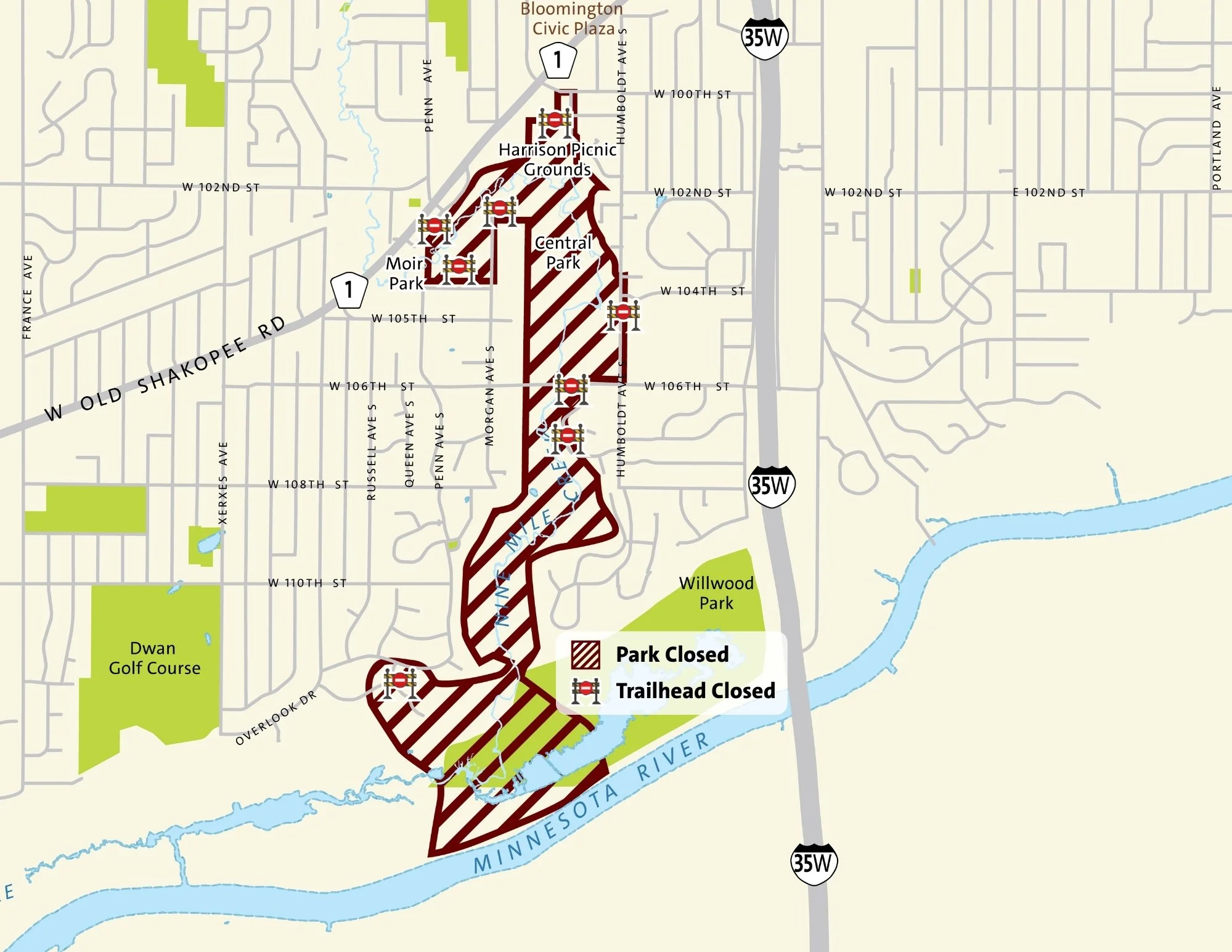
Trail access points will close on September 7, 2026. While they remain open, please use these entry points to access Nine Mile Creek trails. Do not cross private property for access.
See the Draft Final Final Design Storymap in The Plan section below.
Understanding tree removal and other aspects of restoring Nine Mile Creek.
Watch these short videos to better understand the tree removal, oak savanna and prairie restoration, and natural resource management work that will help rebuild and improve the Nine Mile Creek corridor habitat.
Go to FAQs to learn more about tree removal and other project details.
Skip to: Project Updates | The Plan | Public Engagement | The Park | The Need | The Cost | FAQ | Media & Resources | Contact Us
Project Updates
Visit this page often for updated project information.
Fall 2027
Major construction complete.
Summer 2026
September 7: The entirety of Moir/Central Park, including all trail access points will close as major construction gets underway on the project. In addition to the renewal work along the Central Park corridor adjacent to Nine Mile Creek, work at Moir Park will focus on removal of existing shelter buildings and park amenities in September and October in preparation for installation of the new shelter building in 2027. This full park closure will remain in effect until construction is completed
City Council Meeting, August 3, 6:30 p.m.
Award 2026-401 Nine Mile Creek Corridor Renewal Project & 2026-404 Nine Mile Creek Lower Valley Management Plan Project Contracts
City and consultant staff will give a presentation on the project and more information can be found in the City Council agenda packet. There will be an opportunity for public comment for up to 60 minutes prior to the agenda presentation. Speakers are encouraged to sign up by 12 p.m. (noon) on August 3 by contacting the Council Secretary at councilsecretary@BloomingtonMN.gov. Each speaker will have up to two (2) minutes of time to comment. Speakers who have signed up in advance will be called to the microphone before speakers who did not sign up in advance. Public comment will be received in person, via email, or via letter.
June 25: The Contractor has completed installation of storm sewer, the seat wall and footings for the new Bloomington Veterans Memorial at Harrison Park. Initial grading for the installation of the plaza is also complete. Installation will continue in July and August, followed by parking lot reconstruction. Harrison Park and its Nine Mile Creek trail access point remain closed while work continues.
Advertising and solicitation of bids will take place in June and July. Contracts are anticipated to be awarded in August with construction beginning in late summer.
Moir/Central Park, including trail access points, will be closed as major renewal work in the creek corridor begins.
May 2026
Groundbreaking event, May 5, 4:30 - 6 p.m. at Moir Park, 10320 Morgan Ave. S.
Construction at Harrison Park, including the veterans memorial, scheduled to begin.
-
March - April 2026
Bid openings and award contract for Harrison Park/Veterans Memorial project.
Harrison Park closed late April for infrastructure work and site preparation for the veterans memorial.
As the project begins construction, approximately 30 memorial benches in Moir and Central Park must be removed. Bench removal will occur in conjunction with the start of construction. If you or someone you know donated a bench or plaque, email forward@bloomingtonmn.gov for more information on how to reclaim the memorial donation and/or purchase a new memorial at a reduced rate. The City will store benches and plaques for one year after removal.
February - March 2026
NMCWD Permit / Cooperative Agreement
Tree removal.
Tree removal will take place late winter through early spring to prepare the area for upcoming infrastructure and park improvements. Approximately 80–90 individual trees and five acres of land clearing are planned. All work will be completed by April 15 to comply with environmental regulations that protect the endangered long-eared bat.
The removals will provide access and space for construction tied to key project elements, including ADA-compliant trail access from Moir Park, parking lot improvements and the veterans memorial at Harrison Park, creek re-meandering, bridge replacements and trail enhancements. This work also supports long-term streambank improvements and safer, more accessible recreation.
NOTE: Stumps will remain in place and will be removed later during construction. Some of the longer stumps and root balls will be used to perform creekbank restoration.
January 2026
Finalize design plans
City Council orders NMC Corridor Renewal (Corridor Improvements) and NMC Lower Valley Management Plan Renewal (Upland and Natural Resource Restoration Projects).
-
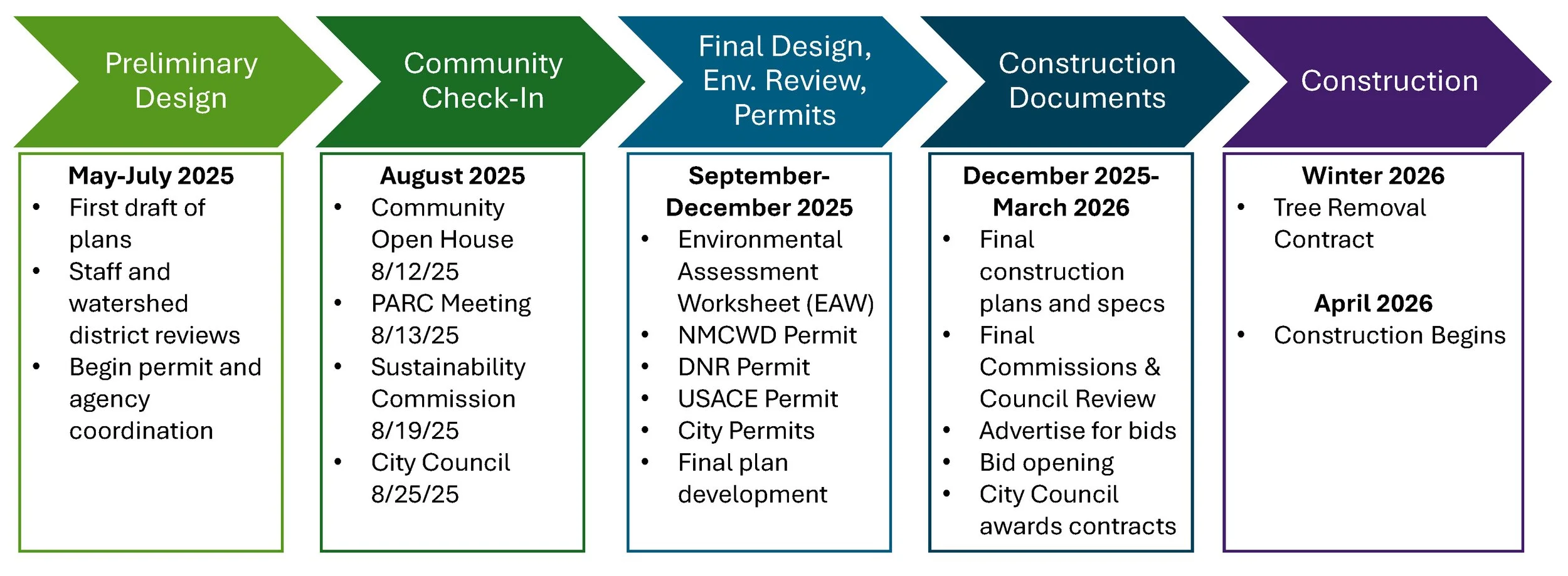
September - December 2025
Final design plan preparation, including:
Environmental review
Permits
Cooperative agreement with Nine Mile Creek Watershed District
At the Monday, December 22 Bloomington City Council meeting, City staff will request approval and authorization to solicit bids for the Veteran’s Memorial and Harrison Park trailhead improvements as part of the renewal project. The December 22 request will also include a contract for winter tree removal. The remaining project components will be presented to the city council on January 26.
These contracts are moving ahead to facilitate the construction schedule. Tree removal will be specific to construction activities that are related to infrastructure and access improvements. It is necessary to complete this work by April 15 due to environmental requirements related to long-eared bats. Tree thinning as part of natural area restoration activities will occur at a later date and will be covered by a separate contract specific to restoration.
November 3, 2025
Due to the erosion and structural issues that have occurred, it is not safe to temporarily replace the bridge north of the Queen Avenue trail access (see July 8, 2025 update for details) for pedestrian use. To avoid further erosion and the possibility of the bridge collapsing into the creek, it will be removed by mid-November and the trail will remain closed until it can be fully replaced as part of the renewal project in 2026.
September 2025
The City’s community engagement efforts to gather public input to help shape the Nine Mile Creek Corridor Renewal Project resulted in a Savvy Award 1st place in the Resident Participation category from the City-County Communications and Marketing Association at its annual conference in Las Vegas, September 4-5, 2025.
July 2025
The extensive community engagement efforts to gather public input and demonstrate how resident feedback shaped project decisions resulted in a Silver Award at the July 30 Minnesota Association of Government Communicators (MAGC) Northern Lights Awards ceremony.
July 8, 2025: Due to heavy rains, a pedestrian bridge in Central Park that crosses Nine Mile Creek approximately a quarter mile north of the Queen Avenue trail access is closed. Park Maintenance staff identified significant erosion and structural issues that make it unsafe for continued pedestrian use. The bridge was scheduled to be fully replaced in 2026 as part of the Nine Mile Creek Corridor Renewal Project. View the map for nearby trail access points north of the closure at James Rd. and south of the closure at Queen Ave. S.
-
Schematic Design development
Project team used technical data and community input to
develop proposed improvements for natural resources,
trails, access, bridges and Moir Park.View schematic design presentation boards via links below:

The Plan
A community-driven planning process will guide improvements for Moir/Central Park, with design principles reflecting priorities identified by the community in the Park System Master Plan, including natural resources, park facility needs, trails, mobility and equity.
As one of the most ecologically diverse natural areas in Bloomington, Central Park requires proper maintenance to protect the area from invasive species. Ensuring native plants and wildlife thrive into the future and residents continue to have access to enjoy and experience the park is a top priority.
Planned Improvements
A wide array of improvements will be implemented including:
Stream and streambank restoration.
131 acres of woodland and wetland restoration.
Invasive species management.
New outdoor gathering space with restrooms.
New playground.
ADA accessibility improvements at Moir and Harrison parks.
Trail enhancements.
Creek remeander and boardwalk installation.
Bridge improvement and replacements.
All items subject to change. Improvements were developed through an environmental and technical feasibility study, along with extensive community engagement from 2024-2025 and approved by City Council.

Timeline
March 2024: Issue Request for Proposals (RFP) for Architect/Engineer.
April - May 2024: Review RFP responses. City Council authorization of contract to SEH on May 20.
June - November 2024: Environmental and technical analysis/feasibility study.
Spring - Fall 2024: Community engagement.
2025: Schematic design, design development and community engagement.
Early 2026: Construction documents and bid for construction.
Spring 2026 - 2027: Primary creek corridor and Moir Park construction. Also includes:
Veterans Memorial construction at Harrison Park spring-fall 2026.
Upland resource management and maintenance (through 2031)
all schedules subject to change
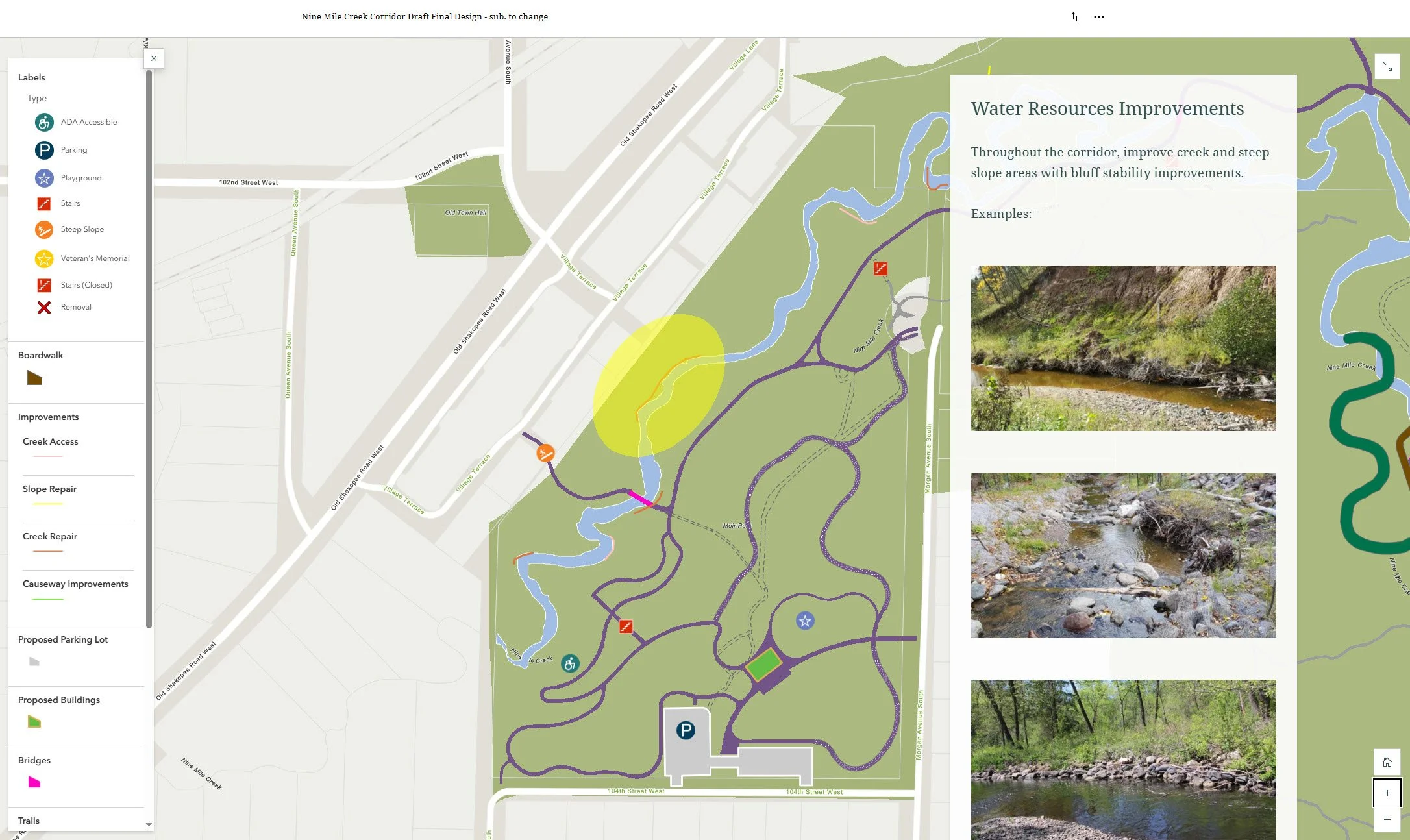
Planning and Design Phases
Predesign
Gather pre-existing information and data to begin the project
Identify opportunities and challenges
Define scope, program, begin budget and schedule discussions
Develop engagement strategies
Schematic Design (30% design)
Create concepts/vision
Incorporates engagement feedback, most flexible part of the design process
Basic ideas, form and function
Preliminary drawings, sketches or renderings may be created
Preliminary cost estimate
Confirm sustainability goals
Team
Staff Contact
Renae Clark, Deputy Director of Parks and Park Projects, Parks and Recreation
forward@bloomingtonmn.gov
Architect/Engineer
Short Elliot Hendrickson, Inc. (SEH), in partnership with:
Construction Manager
City staff and SEH



Design Development (60% - 90% design)
Refined with more detailed drawings and cost estimates
Incorporates feedback, refines and defines design
A vision takes shape into drawings
Product selection begins
Construction Documents
Design finalized
Complete set of construction drawings and specifications prepared
Construction - We are here!
Bidding process, hire contractors
Construction schedule developed
Build per the design
Share status updates with community
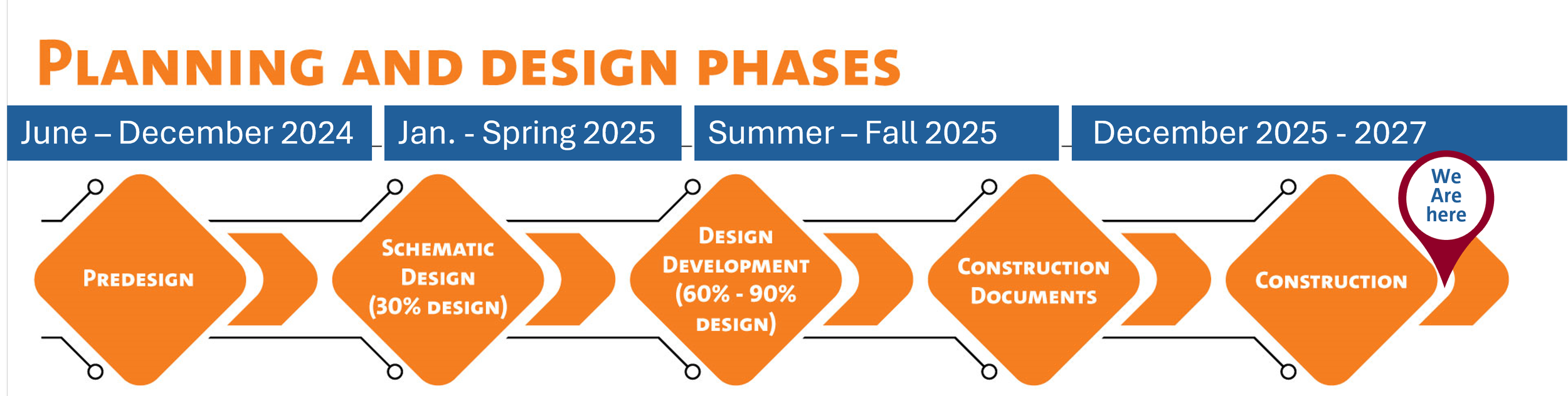
View the Draft Final Design Storymap for plans, images and other detailed aspects of the project.
-
Tree thinning improves light penetration to the forest floor. This is also partially accomplished through buckthorn and invasive shrub removal but requires the selective removal of some trees to also open up the canopy. The percent proposed for removal is based on the current density of trees, the extent of either bare ground or invasive-species dominated surface layer present, and accessibility to complete the work.
The percent removal is intended to be a guideline for the amount of canopy to remove to improve light penetration sufficiently to improve ground conditions. It is also intended to be distributed over the entire zone to provide small pockets of removal, not concentrated areas that would convert it from being forest.
It is intended that areas of tree thinning will remain a diverse mesic forest with higher quality shrub and ground cover layers and less bare soil. These areas will see disturbance to remove invasive species, and some individual tree removal will be observed, but they will remain overwhelmingly full canopy and shady.
Open areas on this figure may also have tree removal, but for specific objectives such as oak savanna restoration or establishment of prairie and wetland.
-
Forestry seeding is completed in conjunction with buckthorn removal and forestry thinning. The intent is to seed exposed areas of soil following removal to rapidly increase ground cover. This is typically done with shade-tolerant grasses. These grasses will provide ground cover but are also very helpful in competing with buckthorn shrub regeneration and reducing the amount of rebound that can occur following removal. If areas are already dominated by high-quality native species, forestry seeding is not needed. This is a strategic use of short-term vegetation competition to help achieve long-term goals.
-
Historically, many of the Minnesota River valley bluffs were dominated by oak savanna habitat. This is a fire-dependent community that is comprised of larger and more sparse trees, usually with a prairie understory. The oak trees are adapted to be fire resistant, while competing trees and shrubs are set back when fires pass through. , With settlement came wildfire suppression and the historic community has shifted to a dense forest dominated by fast growing shade tolerant and coniferous tree species. Many of the old oaks remain present, with many being more than 200 years old. However, they are currently stressed as the younger, faster growing species are out competing them and will eventually lead to their demise. At this time little-to-no natural reproduction of oak trees is occurring.
Oak savanna restoration removes much of the competing trees and shrubs to liberate the oak species and provide them the best opportunity to thrive in their more natural setting. Specimen trees that are already present and can co-exist with the oak trees will remain and provide for a more diverse and denser canopy than historic conditions, which will moderate and allow transition to the forested non-savanna present on the slopes. The project proposes to complete a controlled burn, which will also mimic the beneficial fires that sustain this rare community. Long-term, natural reproduction of oak trees is anticipated, but these slow growing specimens will require long-term management to sustain them.
Consistent with savanna habitat, the buckthorn and invasive shrub layer will be removed, and a ground layer of native prairie will be established. By preserving specimen trees the canopy will be fuller than a true savanna, but this targeted restoration is one of the most significant ecological uplifts proposed with this project.
Public Engagement
-
An in-person open house was held March 26, 2025, 4:30 - 6:30 p.m. in the Center for the Arts Rehearsal Hall at Bloomington Civic Plaza. The purpose was to share proposed concepts for improvements at Moir Park as well as improvements to trails, bridges, the creek and natural environment.
Among the approximately 200 attendees were community members, park users, stakeholders, and staff from the City of Bloomington, consultants and project partners.
For full details, read the Phase 3 Open House Community Feedback Report.
-
In-person, open house-style community engagement events were held October 21 at Moir Park and October 22 in the Black Box Theater at Bloomington Civic Plaza to share preliminary concepts and analysis for the Nine Mile Creek Corridor Renewal project.
Attendees included:
Community members
Park users
Stakeholders
11 City of Bloomington staff
3 SEH staff
2 TLAL-LI staff
1 Nine Mile Creek Watershed District staff
Identical presentation boards were displayed at both events, with information on project background, schedule, funding, and summaries of concepts developed related to the environment, trails and mobility, and infrastructure.
The goal was to gather additional input on desired park amenities, prioritization of potential improvements, accessibility, natural area maintenance and more.
Project team members were available throughout both events to engage attendees and answer questions.
For details, view the full Phase 2 Open Houses Community Feedback report.
-
An open house was held at Moir Park on August 7, 2024 during which participants were engaged to provide input and ideas to help develop park concept plans for further community review and feedback.
Input was gathered on desired park amenities, features, convenience options, natural and sustainable resources, parking, accessibility and much more.
For full details, view the Moir Park Visioning Open House Community Feedback Report.
-
To assess options and opportunities for the bicycle community in the Nine Mile Creek Corridor, a focus group was conducted on August 1, 2024.
The goal was to gather feedback from representatives interested in biking and connectivity in the Nine Mile Creek Corridor and surrounding destinations and connections throughout the City of Bloomington. The focus group included mountain bikers, road cyclists, commuter bicyclists along with representatives from:.
Hennepin County
Quality Bicycle Products
Bloomington Off-Road Cycling Alliance (BORCA)
Born Again Jocks
Project team members from the City of Bloomington and SEH.
For details, view the Bike and Trail Connectivity Focus Group Feedback Report.
-
As part of the Nine Mile Creek Restoration Project, the project team hosted a community Creek Walk July 30, 2024 that invited the community to join the team’s environmental experts at a series of natural resource stations.
Each station had experts available to hear community feedback and discuss approaches and best practices to restoring and investing in the future health of the Nine Mile Creek Corridor project area.
View the story map that illustrates comments and discussion that occurred during this event.
View the Creek Walk Feedback Report for a summary of event content and participant feedback.
-
To assess accessibility options and opportunties in the Nine Mile Creek Corridor, a focus group was conducted on July 25, 2024.
The goal was to gather feedback from representatives of the ADA Accessibility community about how they access the area, what amenities are desired, barriers to use and other accessibility accommodations that should be considered.
Attendees/Representatives:
MN State Council on Disability
TRAIL manager
HRC Commissioner and Resident
Martin Luther Manor, BLP alumni, Veterans Memorial volunteer
Nine Mile Creek Senior Living
Bloomington Resident
Project team members from the City of Bloomington and SEH.
For details, view the ADA Accessibility Focus Group Feedback Report.
-
Here’s what we heard at the June 5 event:
Input was collected from more than 200 attendees via comment cards, video interviews, a mapping activity, one-on-one discussions, and a comment board asking for what participants are most excited and concerned about with the project.
Comments were analyzed and summarized, then project staff reviewed for accuracy and created the following list of themes:
Preservation & Restoration of Natural Habitat
Many participants value the unique natural environment of Nine Mile Creek and want to preserve its tranquility and biodiversity.
Participants appreciate efforts to enhance the natural beauty and ecological health of the area, including removing invasive species, stabilizing creek banks, and maintaining natural vegetation.
Accessibility and Safety
Comments highlight the importance of maintaining and improving accessibility, particularly for older adults, people with disabilities, and families with young children.
Biking & Connectivity
Those not in favor of bike trails within the natural areas expressed concerns about the potential for increased accidents, conflict between bikers and pedestrians/dog walkers, and disruption of the serene environment.
Those in favor of bike facilities noted that biking encourages outdoor activity for all ages and can be managed to minimize environmental impact.
Some were opposed to shared bike and pedestrian trails but were in support of dedicated bike trails separate from pedestrian paths.
Community Engagement and Transparency
There is a desire for a high level of community involvement and transparency in the planning process.
-
Why are we engaging you?
Feedback from residents continues to shape the Bloomington Forward plan. The City of Bloomington is committed to keeping you informed on the timeline, features and benefits and construction progress of this project. We are also committed to involving you in the process by providing ongoing and inclusive opportunities for public input into the decisions that are made over the lifecycle of the project, including (but not limited to) park amenities, accessibility and mobility.
Your input will help provide information used by the City Council to make final decisions on the project.
How will we engage with you?
The City will use the International Association of Public Participation engagement framework, we will:
Design engagement opportunities to involve residents, stakeholders and other interested parties.
Ensure you have a sense of connection to the project.
Provide follow-up to engagement activities that reflects how your input will be used.

Project Concept Community Engagement and Updates, Plan, Process and Schedule
Click the arrows below to expand the tabs for more information on scheduled events and activities.
-
City Council Meeting, August 3, 6:30 p.m.
Award 2026-401 Nine Mile Creek Corridor Renewal Project & 2026-404 Nine Mile Creek Lower Valley Management Plan Project Contracts
City and consultant staff will give a presentation on the project and more information can be found in the City Council agenda packet. There will be an opportunity for public comment for up to 60 minutes prior to the agenda presentation. Speakers are encouraged to sign up by 12 p.m. (noon) on August 3 by contacting the Council Secretary at councilsecretary@BloomingtonMN.gov. Each speaker will have up to two (2) minutes of time to comment. Speakers who have signed up in advance will be called to the microphone before speakers who did not sign up in advance. Public comment will be received in person, via email, or via letter.
-
Playground Inclusion Community Conversation
September 9, 6:30-7:30 p.m., Moir Park Shelter 1, 10320 Morgan Ave. S.
During this open house-style community conversation, you'll learn more about accessibility options and have a chance to share your input for inclusive playground design at Moir Park as part of the Nine Mile Creek Corridor Renewal Project.
If you can’t attend in person, visit Let’s Talk Bloomington to provide feedback online.
-
Nine Mile Creek Corridor Renewal Project Open House
August 12, 2025, 5 - 6:30 p.m. at Moir Park, 10320 Morgan Ave. S.Review and learn more about proposed improvements to Moir Park including playground concepts, a new open-air park shelter building, reimagined disc golf course and more. You’ll also get an update on design details for the natural resources restoration in the Nine Mile Creek corridor.
———————————
Online Review
If you missed the August 12 in-person event, you can still review draft designs and provide feedback via a short survey online at Let’s Talk Bloomington. Survey closes August 31.———————————
Parks, Arts and Recreation Commission Meeting
August 13, 2025, 6 - 8 p.m., Bloomington Civic Plaza, 1800 W. Old Shakopee Rd.———————————
Sustainability Commission Meeting
August 19, 2025, 6 - 8 p.m., Bloomington Civic Plaza, 1800 W. Old Shakopee Rd.———————————
Project Update to City Council
August 25, 2025, Bloomington Civic Plaza, 1800 W. Old Shakopee Rd. Meeting begins at 6:30 p.m. -
CITY COUNCIL UPDATE
Monday, April 28: Nine Mile Creek Corridor Renewal Project schematic design update for Bloomington City Council.
Click the date link above to go to the City of Bloomington website where you’ll find meeting details when they become available, including agenda and information packet.
-
Nine Mile Creek Corridor Project Public Engagement Event - Schematic Design
March 26, 4:30 – 6:30 p.m.
Rehearsal Hall, Bloomington Civic Plaza, 1800 W. Old Shakopee Rd.
This is another in a series of opportunities for the public to review progress of the project and provide comments to fine tune designs.
-
Agency coordination
Commission and Council review
CITY COUNCIL UPDATE
Monday, December 2, 2024: Nine Mile Creek Corridor Renewal Project update for Bloomington City Council.
Click the date link above to go to the City of Bloomington website where you’ll find meeting details including a link to the meeting agenda and information packet.
-
Concept Review
Monday, October 21, 3-5 p.m. at Moir Park, 10320 Morgan Ave. S.
Tuesday, October 22, 5-7 p.m. at Bloomington Center for the Arts' Black Box Theater, 1800 West Old Shakopee Road.
The project team has listened to the community, collected technical information about the site and studied possibilities for improvements to natural resources, trails, and Moir Park. Concepts to illustrate what’s possible and provide alternatives for public input will be shared. This is part of the predesign/feasibility study process; the first phase of planning and design.
Let's Talk Bloomington online survey and input opportunity, October 25 - November 15.
-
Project team developing concepts
-
August 7 , 5 - 7 p.m.
Moir Park picnic shelter, 10320 Morgan Avenue South.
Help generate ideas for desired activities and improvements specific to Moir Park during this community workshop.
The City is seeking input on amenities and other improvements. Meet with City staff and consultants and provide your ideas to help develop park concept plans for further community review and feedback.
While there, enjoy the playground, yard games and treats and buy dinner from the Potter's Pasties and Pies food truck!
Can't make it to the event? Provide feedback by 12 p.m. on August 23 online at Let's Talk Bloomington.
The survey is closed.
-
Nature & Ecology Creek Walk
July 30, 5 - 6 p.m.
Take a one-hour walk with staff from the project's natural resources team.
Walk begins at Harrison Park, 1701 West 100th Street.
Focus group meetings on connectivity and ADA Accessibility.
Late July.
-
Community Celebration Kickoff event June 5.
Engagement process planning.
PREDESIGN and SCHEMATIC DESIGN PROCESS
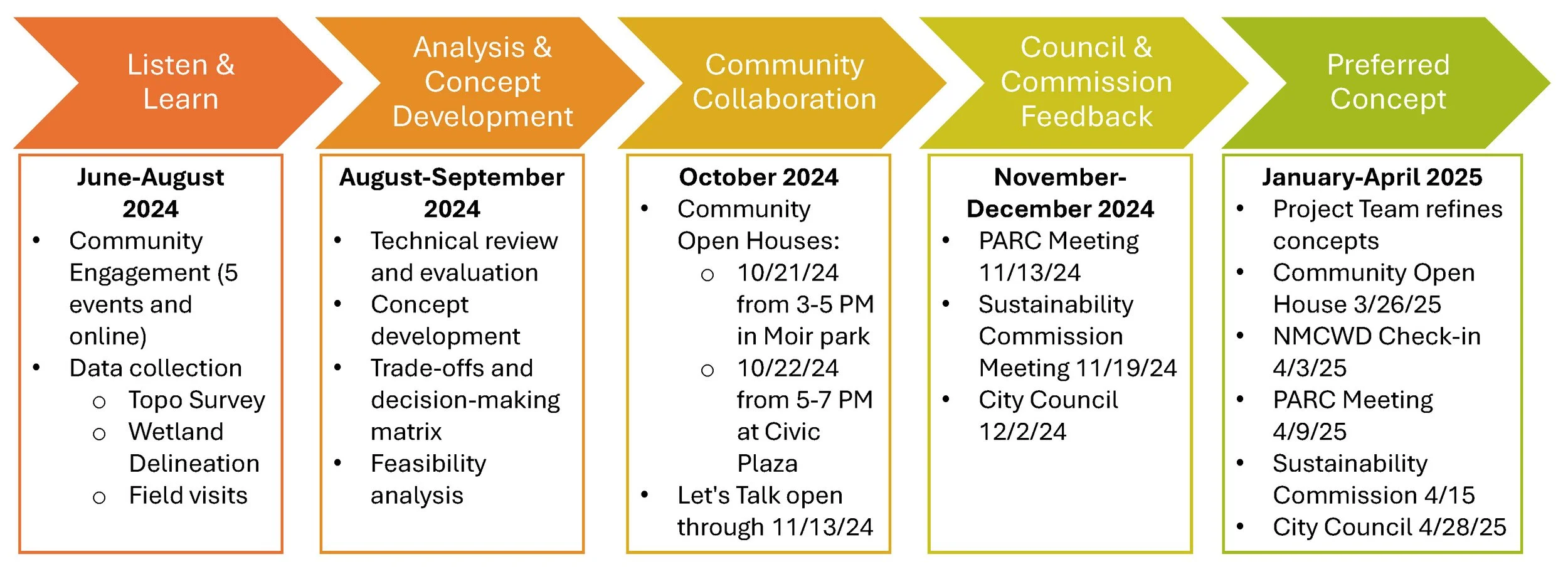
This graphic provides an overview of the community engagement plan, process and schedule for developing the project concept plan. It outlines the roadmap that will lead the community, commissions and City Council to the shared preferred concept and big picture plan, including a decision regarding potential bike facilities for the Nine Mile Creek Corridor Renewal Project.
Engagement Summaries and Recaps
The Park
Occupying more than 200 acres and two miles of Nine Mile Creek as it enters the Minnesota River, Moir/Central Park is one of the largest parks in Bloomington. Visitors come from throughout the southwest metro area to enjoy amenities including:
Baseball and softball fields
Disc golf course
Playgrounds
Two picnic shelters
Outdoor picnic areas
Volleyball court
Seasonal restrooms
Miles of improved and natural trails
Who does Nine Mile Creek and Moir/Central Park serve?
With its trails, sports features and traditional park amenities, Moir/Central Park, including the Nine Mile Creek waterway, serves walkers, hikers, nature enthusiasts, families with children of all ages, recreational athletes, public music and arts activities, private event rentals and much more!


The Nine Mile Creek Corridor provides key access to regionally significant trail networks, including the Cedar Lake Regional Trail, the Minnesota River Bluffs Regional Trail, Nine Mile Creek Regional Trail and the Nokomis-Minnesota River Regional Trail.


The Need
The 2021 Park System Master Plan assessed existing park infrastructure, and established needs and priorities based on extensive stakeholder and community engagement and input.
Priorities identified through this process included new park shelter buildings, outdoor gathering spaces, natural resources, and increasing diversification of park amenities.
Did You Know?
The Nine Mile Creek Corridor Renewal project area is part of a larger area identified by the Minnesota Department of Natural Resources as a conservation corridor. Increased volume of urban stormwater runoff causes erosion of steep slopes, streambanks, and bridge supports in Nine Mile Creek. The City will study stormwater flows, look for ways to control and repair erosion, and take a fresh look at the creek crossings from an ecological perspective.
The Nine Mile Creek Corridor is home to a variety of natural environments, including several acres of “remnant prairie” that predate human settlement. These valuable habitats require careful upkeep to maintain their health and protect against invasive species.
The Cost & Funding
The Nine Mile Creek Corridor Renewal project will focus on restoration of over 100 acres of prairie, woodland, wetland and creek habitat and improvements to other outdoor amenities in park spaces. To ensure the park continues to connect residents to nature and outdoor activities, the City will invest $20 million to:
Protect eroded streambanks
Restore natural habitat
Add new amenities to the park
Improve trails and accessibility
Project Budget and Funding
Funding Sources: $20M
Local Option Sales Tax
PMP Park Trails Funding
Stormwater Utility
Potential Sources
Nine Mile Creek Watershed District
Grants
Allocations
Water and Natural Resources: $10.5M
Trails and Mobility: $8.0M
Moir Park: $5.3M
Spreading the cost among residents and nonresidents
In May 2023, Bloomington received legislative authorization to present voters with a referendum to fund the investments included in the Bloomington Forward plan via a half-percent local sales tax. Approved by Bloomington voters on November 7, 2023, an estimated 65% of the tax will be paid by nonresidents, according to research by the University of Minnesota. That means nonresidents will contribute an estimated $13 million toward the Nine Mile Creek project.
How Does The Sales Tax Work?
The local half-percent sales tax will be applied the same way as the state sales tax. The tax amounts to a half-cent for every $1 spent. For example, a $10 purchase will cost an additional 5 cents.
The local sales tax has the same exemptions for purchases as the state sales tax. These include groceries, clothing, prescription and over-the-counter drugs, feminine hygiene products and baby products. Sales of motor vehicles and boats are also exempt. For more information, view this list of taxable items and this list of most nontaxable items from the Minnesota Department of Revenue.
Collections from the local sales tax will be used to make bond payments to finance the project for up to 20 years. The tax will expire when the bonds for the project are paid off. This approach allows current residents to take advantage of the improvements while the bonds are being repaid.
Did You Know?
The average cost of the half-percent sales tax for Bloomington residents will be approximately $100 per household each year, or $8.33 per month.
For more information about the local option sales tax, visit blm.mn/sales-tax.


Frequently Asked Questions
Get answers to common questions about the Nine Mile Creek Corridor project here!
-
The Nine Mile Creek Corridor is a valued natural area and portions of the corridor are experiencing erosion, invasive species pressure, habitat degradation and poor regeneration of native plants and trees. The project is intended to improve long-term ecological health, protect natural resources and maintain access to nature for future generations.
-
While many areas appear wooded and provide important recreational benefits, portions of the corridor are not functioning as healthy, self-sustaining native ecosystems. Decades of invasive species pressure, altered disturbance patterns and limited native regeneration have changed the ecological condition of the site. The restoration project is intended to improve ecosystem health and resilience over the long term.
-
Tree removal is one of the methods used to restore native plant communities and improve ecological conditions. Removal is targeted to support restoration goals, reduce invasive species impacts, improve native plant diversity, and restore historic habitats such as oak savanna and woodland.
-
Tree removal varies significantly across the project area. Some restoration areas will see more intensive management, while large portions of the corridor will experience little or no tree removal. The project focuses on restoring ecological function rather than achieving a specific tree removal target. There will also be 150-200 trees reinstalled around the Moir and Harrison Park area along with many plants installed to beautify the landscape.
-
Oak savanna was once a common native habitat in Minnesota and is now one of the state's rarest ecosystems. Restoring oak savanna increases habitat diversity, supports a wide range of native plants and wildlife and helps create a more resilient landscape.
-
Without active management, invasive species, erosion, and poor native plant regeneration are expected to continue negatively affecting the corridor. The restoration plan is based on the expectation that active management will provide greater long-term ecological benefits than maintaining current conditions.
-
Yes. The project restores a mix of native woodland, oak savanna, wetland, and prairie habitats. Many areas will continue to have substantial canopy cover with dappled sunlight with shade, while some areas will become more open to support restoration goals. Selective thinning will improve airflow and growing conditions, supporting the long-term health of remaining trees and creating a more comfortable trail experience. The project is designed to balance ecological restoration with the wooded character and recreational value users enjoy today.
-
Maintaining a variety of species is important, and the project is intended to increase overall ecological diversity. In some locations, restoring oak-dominated communities is appropriate because they historically occurred there and support unique plants and wildlife. Restoration also improves growing conditions for remaining trees by reducing competition and increasing access to light.
-
No ecosystem is free from risk. However, restoration activities are intended to improve tree vigor and resilience by reducing competition, improving air circulation, and creating growing conditions that better support healthy oak communities. While future pests or diseases cannot be predicted with certainty, active management is intended to reduce vulnerability and improve long-term forest health.
-
Prescribed fire is a widely used ecological management tool that helps maintain native habitats, control invasive species, and support native plant communities. Burns are carefully planned and conducted by trained professionals under specific weather and site conditions to ensure safety.
-
Safety is the highest priority during prescribed burns. Burns are conducted only when conditions meet strict requirements, and crews follow detailed plans designed to minimize risk. Prescribed fire has been used safely for decades throughout Minnesota and across the country.
-
Some wildlife may temporarily relocate during restoration activities. Over time, restoring native habitats is expected to improve habitat quality and support a greater diversity of birds, pollinators, mammals, reptiles, amphibians and other wildlife.
-
The restoration plan is intended to improve ecological resilience by increasing native biodiversity, improving habitat quality, supporting healthy tree growth and creating ecosystems that are better able to adapt to changing environmental conditions.
-
As with many projects, restoration plans have been refined as additional site information and design details became available. These refinements help better align restoration activities with existing habitat conditions and project objectives and are a normal part of project development. The refinements of the restoration areas are environmental enhancements and not impacts.
-
The plan was developed by ecological consultants and City staff with expertise in natural resource management using established restoration science, field assessments and best management practices. Academic expertise and community feedback also informed the planning process.
-
Occupying 240 acres, Moir/Central Park in the Nine Mile Creek Corridor is a beautiful slice of nature, featuring trails and many outdoor amenities that residents enjoy. The Nine Mile Creek Corridor serves as a key connection to the Minnesota River Valley, as well as a regional trail connection to the Cedar Lake Regional Trail, the Minnesota River Bluffs Regional Trail, Nine Mile Creek Regional Trail and the Nokomis-Minnesota River Regional Trail.
As one of the most ecologically diverse natural areas in Bloomington, Nine Mile Creek requires greater maintenance to protect the area from invasive species and ensure that native plants and wildlife can thrive into the future.
To ensure Moir/Central Park and the Nine Mile Creek Corridor continue to connect residents to nature and outdoor activities, the City will restore eroded riverbanks, enhance and protect natural habitat, add new amenities to the park and improve access.
-
The Nine Mile Creek Corridor is one of the most ecologically diverse areas in Bloomington. The project will improve access to the area without disrupting the natural surroundings of the Nine Mile Creek Corridor. The City will restore eroded riverbanks and protect natural habitat while improving access for the public.
-
No. The project will focus on restoring eroded banks along the creek and protecting natural habitat from invasive species in order to ensure that native plants and wildlife thrive in the future.
-
New amenities for Moir Park include an outdoor gathering space, specifically a new picnic shelter with restrooms. There will also be a new accessible playground. Other new amenities and updated greenspace will be included in place of the diamond field as informed through community engagement.
-
The investments for Nine Mile Creek Corridor will focus primarily on preservation and habitat restoration. Improving access is also a goal, but new trail projects, including those for bikes, would have to go through a rigorous review process to make sure the corridor is protected before they would be included in the plan. This review process will gather input from Bloomington residents as well as from wildlife and habitat experts.
In 2024, the City will explore various concepts to improve access, including a trail connection from Moir Park to the lower trails as well as new bridges. However, such ideas are preliminary and will require extensive review and community input before moving forward.
-
There will be 131 acres of woodland and wetland restoration. The goal of this work is to manage invasive species and increase diversity. Specific improvements to Nine Mile Creek include restoring the creek, banks, and bluffs and repairing erosion.
-
There are several partners, including Nine Mile Creek Watershed District and U.S. Fish and Wildlife Service. The City will seek other partnerships through grants in 2024.
-
Funding for the project is generated through a voter-approved half-cent local option sales tax.
For more details, visit the Cost & Funding section above.
-
Project information, updates, presentations, construction details, and project documents are available on this website.
Questions? Email forward@bloomingtonmn.gov.
Media & Resources
Learn more about Bloomington Forward.
-
-
A Path to a Sustainable, Healthy Forest - Bloomington Briefing - August 2026
Tracking Your Tax Dollars: Protecting Native Oak Trees in Bloomington - KSTP - July 2
Bloomington Veterans Memorial: Groundbreaking set for unique digital dog tag tribute - Fox 9 - May 4, 2026
Moir Park Improvement Plan Discussion - Sun Current - August 3, 2024
Nine Mile Creek Walk - Sun Current - July 26, 2024
Nine Mile Creek Celebration - Sun Current - May 19, 2024
Twin Cities gem is about to undergo a major renovation - KMSP Fox 9 - June 5, 2024
-
YouTube Playlists
Publications
-
Explore Oak Savanna Restoration at Parkers Picnic Grounds - July 22, 2026
Understanding Oak Savanna Restoration at Nine Mile Creek - July 1, 2026
Why Tree Removal is part of Restoring Nine Mile Creek - June 25, 2026
Discover Bloomington Outdoors - Along France Avenue - June 10, 2026
Bloomington breaks ground on Nine Mile Creek Renewal and Veterans Memorial - May 8, 2026
Unique digital dog tag tribute part of new veteran’s memorial in Minnesota - Fox 9 - May 4, 2026
Tree Removal In Progress - March 3, 2026
City Council Update - January 26, 2026
Helping old-growth oaks survive and thrive in Bloomington - August 13, 2025
Bloomington Veterans Memorial at Harrison Park - April 30, 2025
City Council Update - April 28, 2025
Bloomington Today: The BUZZ - April 2, 2025
Nine Mile Creek Corridor Renewal Project Update - January 29, 2025
Entry Points of Nine Mile Creek
Controlling Erosion Along Nine Mile Creek
What's Living in Nine Mile Creek?
Nine Mile Creek Celebration Event Recap - June 5, 2024
Understanding the Hydrology of Nine Mile Creek
What’s Blooming in Bloomington: Horsetails.

FEATURED STORIES
Contact Us
Do you have questions or comments? Email us at forward@bloomingtonmn.gov
Do you want to receive email updates about the Nine Mile Creek Renewal Project?
Sign up for E-Subscribe and select the Trails Projects In and Around Bloomington topic.